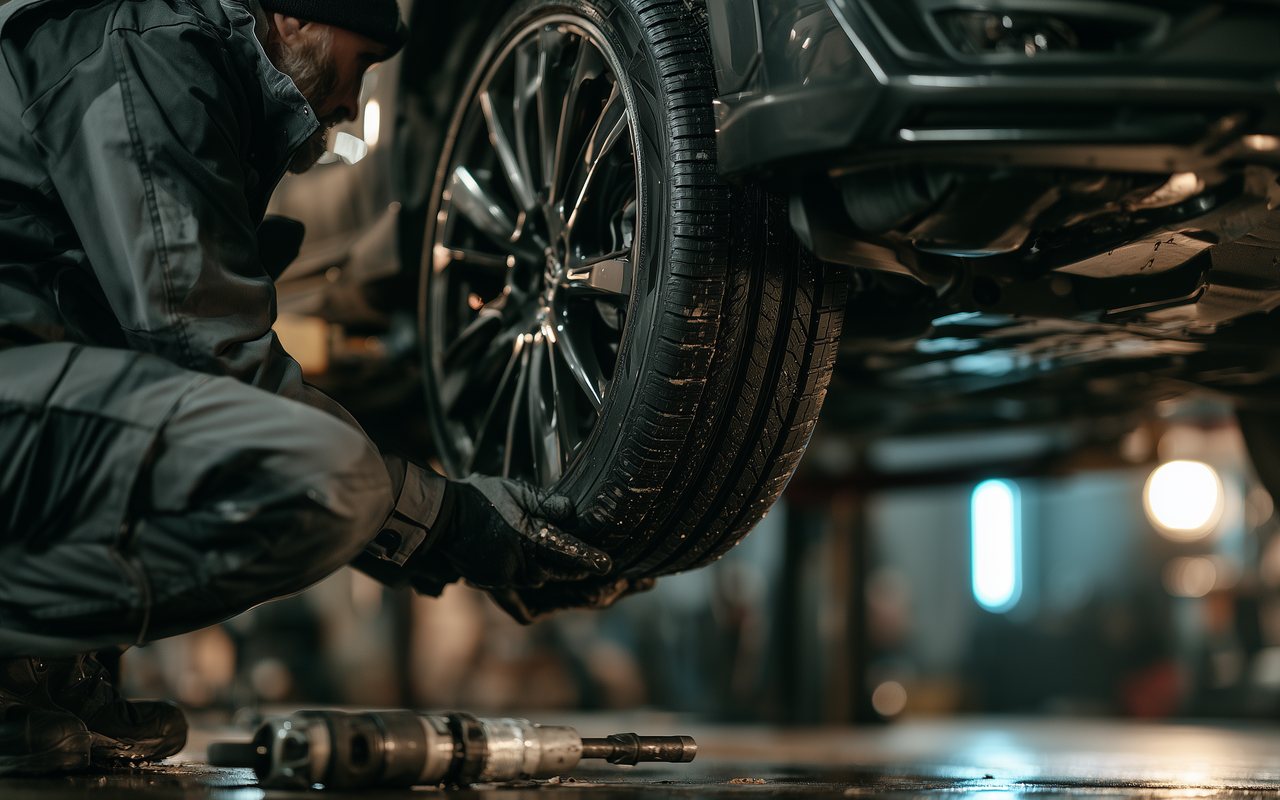
A seasonal tire change is more than swapping rubber. We take the wheels off, assess the tires coming off — tread depth across the full width, how evenly they've worn, their age and the state of the sidewalls — and only then mount the set for the season. Every wheel goes on the balancer, because even a new tire is rarely balanced perfectly, and half an ounce of difference is something you feel in the wheel at highway speed.
What we check while we're there
A wheel off the car exposes things you otherwise never see. We look at the rotor and pads, check the brake line and the CV boot, and see whether the caliper is weeping. If something needs attention we say so right away — along with whether it's a job for today or for the next visit.
tread depth measured at three points across the width
uneven wear, which usually points at alignment or suspension
the tire's age and the state of its sidewalls — cracks, bulges, curb marks
valve stems and TPMS sensors
the state of the rotors, pads and lines visible with the wheel off
When you need it
At the seasonal change — winter tires stop making sense much above 45°F, summer tires go hard below it. Off-season: when the tread is getting close to the legal minimum, when the car starts floating in the wet, or when a bulge appears in a sidewall. That last one means the casing is damaged and the tire is replaced no matter how much tread is left.
How we do it
Four wheels is usually 30 to 45 minutes. We torque the wheels with a torque wrench to the figure your manufacturer specifies — not by feel — and we ask you to come back for a re-torque after about 30 miles, because a freshly mounted wheel can settle. We take the old tires away for disposal.
Alignment is how the wheels sit relative to each other and to the car's axis. We measure it on an alignment rack: toe, camber, and the steering-axis angles — caster and SAI. The car sits on the plates, the heads go on the wheels, and we read the result against your manufacturer's figures for that exact body and suspension.
What can be adjusted, and what can't
How much can be adjusted depends on the design. On most cars front toe is adjustable, rear toe often, camber less often. If a measurement lands outside the adjustment range, it usually isn't a settings problem at all — it's a worn part, or body geometry after an impact. Then we're talking about a repair, not turning tie rods.
When you need it
The classic signs are a car pulling to one side on a level road, a steering wheel held crooked while going straight, and tires wearing on one shoulder. An alignment is also the mandatory last step after any suspension or steering part is replaced — a control arm, a tie rod, an end link, a strut assembly.
the car pulls to one side on a level road with healthy brakes
the wheel doesn't sit straight when driving straight
a tire worn on its inner or outer edge
after any suspension or steering part is replaced
after a hard hit on a pothole or a curb
What you get
A printout from before and after the adjustment, with the manufacturer's figures next to the measured ones. If something couldn't be brought into spec, that shows on the printout along with the reason.
An engine oil and filter change. We drain the oil warm so it carries the suspended debris out with it, fit the new filter with a fresh gasket, and always use a new drain-plug washer — a crushed old one is the commonest reason a pan starts weeping after a service. We fill to the right level and check it again once the engine has run.
Which oil, and why it isn't a detail
We choose oil by the engine manufacturer's specification, not by viscosity alone. On newer engines with a particulate filter the sulphated-ash content matters — an oil outside the spec can clog a GPF or DPF far sooner, and that repair costs many times what the oil did. If your car is on an extended service interval, the oil needs a separate approval for that interval.
When you need it
At your manufacturer's interval, by mileage or by time — whichever comes first. Short trips, city driving and frequent cold starts use oil up faster than highway miles, so it's worth shortening the interval if that's how the car lives. Signs outside the schedule: oil that's visibly thin and black, a dropping level, a smell of fuel on the dipstick.
What's included
engine oil meeting the manufacturer's specification
An inspection on the lift is an orderly look at the car from underneath and above — not a repair, an honest assessment. We work through a list of checkpoints and write down what's sound, what has life left in it, and what needs attention now. It ends in a conversation, not just a sheet of paper.
What we look at
brakes: rotor and pad thickness, the state of the lines, caliper sealing
suspension: shocks for leaks, bushings, links and ball joints
steering: play in the tie rods and ends, the state of the boots
tires: tread, age, evenness of wear, pressure
lighting and basic electrics
fluid levels and any signs of leaks from the engine, transmission and cooling system
the exhaust and its mountings
Why bother when the car drives fine
Because most expensive failures announce themselves earlier, and cheaper. A leaking shock is visible long before the car starts floating. A weeping brake line at that stage is a line replacement, not a tow. An inspection mostly exists so the spending can be planned instead of landing on you all at once.
When you need it
Before a long drive, before winter, when buying a used car, and at the intervals your manufacturer recommends. It's also worth doing when a car changes hands within a family, or comes back on the road after sitting a while.
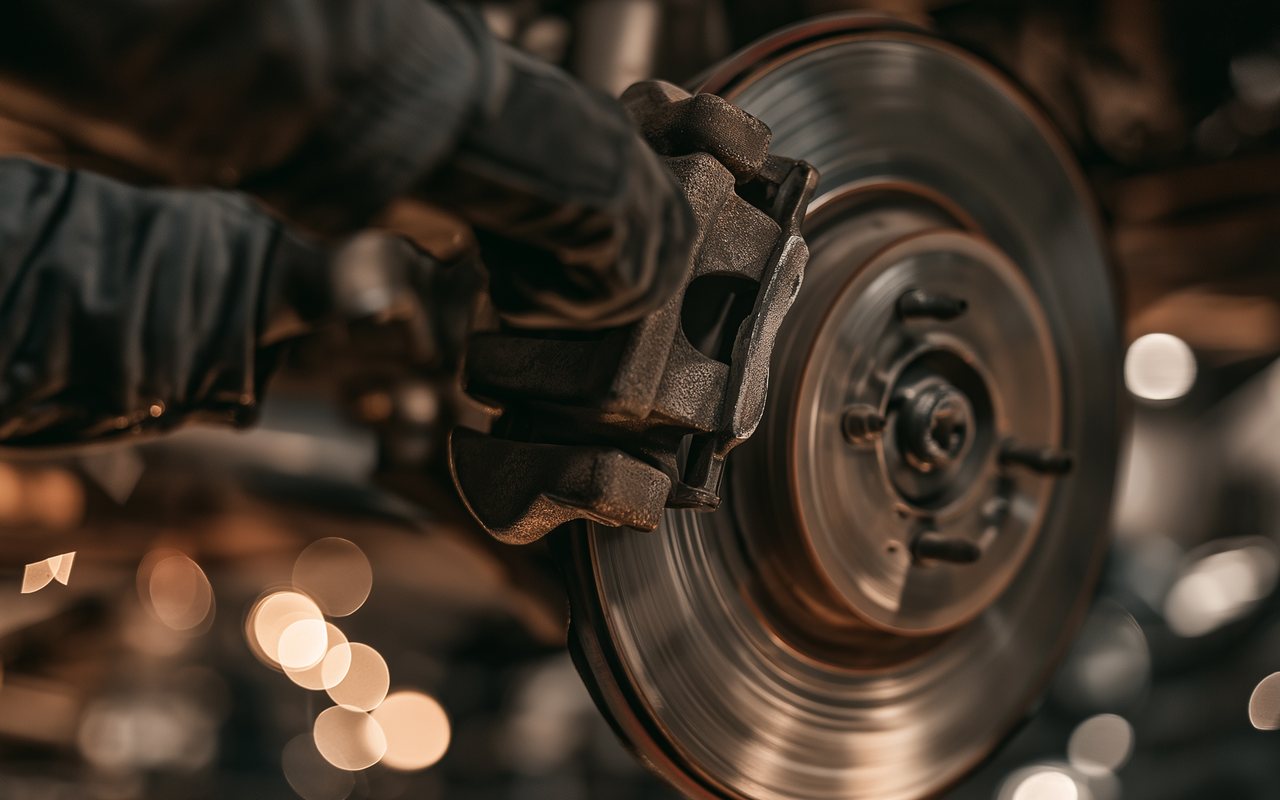
A brake repair starts with a measurement, not with an order for parts. We measure rotor thickness against the manufacturer's minimum, check lateral runout, assess pad material thickness and the state of the wear sensor. We set the scope only after that, and we always agree it with you before ordering anything.
Why always in pairs, per axle
We replace rotors and pads in pairs across an axle, because unequal braking force left to right pulls the car under braking — and that is worse than slightly worn but even brakes. For the same reason we pay attention to the caliper: seized slide pins, or a piston that won't release, will chew through a new set in a couple of thousand miles and it will look like a faulty part.
Brake fluid
Brake fluid is hygroscopic — it absorbs water from the air over time, and its boiling point falls. Day to day you'd never know; you find out on a long descent or after a series of hard stops, when the pedal suddenly goes soft. So the fluid gets changed about every two years regardless of mileage, and we bleed the system fully after any work on it.
rotor thickness and lateral runout measured
pads and the wear sensor assessed
the caliper gone over: piston, slide pins, boots, lubrication
hard lines and hoses checked for corrosion and weeping
a fluid change and bleeding the system
the parking brake and its cables
When you need it
A squeal or a grind when braking, a longer stopping distance, a pulsing pedal or wheel as you slow, a car that pulls under braking, a soft pedal. Metal on metal means the pad material is gone and usually the rotor with it — that one isn't worth waiting on.
Diagnosing suspension is a look on the lift plus a play test. We check the shocks for leaks and lost damping, look over the springs — breaks happen most often at the bottom coil — and go through control-arm bushings, sway-bar links, ball joints and boots. Only then does a list of what genuinely needs replacing come out of it.
Why shocks come in pairs
A shock wears out gradually, and a new one on one side of an axle against a tired one on the other gives uneven damping — the car answers a bump differently on the left than on the right. So we replace them in pairs across an axle. It's worth doing the bump stops and boots at the same time: they cost very little, and they are what decides whether the new shock lasts the miles it should.
What happens after the repair
Replacing suspension parts changes the alignment, so we recommend measuring and adjusting afterwards. Without it a freshly repaired car can eat a set of tires in a single season — and that is the commonest reason a well-done repair ends in disappointment.
When you need it
knocks and taps over bumps, especially small repeated ones
the car floats on the road, or keeps rocking after a bump
uneven tire wear
an oil trace on a shock body
a change in how the car behaves braking or through a curve
We connect to the diagnostic port and read the control modules — engine, ABS, airbags, emissions and whatever else the car exposes. The scan is only the beginning: a code tells you which parameter went out of range, not what broke. So we read live data too, and if the fault is intermittent we take the car out with a logger running.
Why a code on its own isn't a diagnosis
The same code can have several completely different causes. An oxygen-sensor code is sometimes a failed sensor, but just as easily an exhaust leak upstream of it or unmetered air getting in past the mass airflow sensor. Clearing a code without finding the cause buys quiet until the next drive cycle and nothing more — so we tell you what the scan actually means before we order anything.
How we work
a fault memory read from every module the car exposes
live sensor data with the engine running
a test drive with logging, for intermittent faults
a mechanical check wherever the scan points to one
a walk-through of the result and a price before any work starts
When you need it
When the check-engine light comes on, when the car starts behaving differently — hesitating, stalling, starting badly, drinking more fuel — or when you want to know what's sitting in the modules before you buy. A light that flashes while you're driving means pull over: that usually signals a misfire, which can destroy a catalytic converter in minutes.
A/C service is not just a recharge. We recover the refrigerant into the machine, weigh what came out and compare it with the factory charge — that measurement alone tells us whether the system is sealed. Then a vacuum, a leak test, and only then a refill with a weighed charge and oil. At the end we check the temperature at the vents and the pressures on both sides of the system.
Why topping it up is the wrong answer
An A/C system is sealed, and a healthy one doesn't consume refrigerant. If a noticeable amount is missing after a season, it's leaking somewhere — most often past the compressor seals, through a corroded condenser at the front of the car, or a line. Topping it up without finding the leak works until next summer and vents refrigerant to the atmosphere on the way, so we look for the cause instead of refilling it every year.
The evaporator clean, and what you breathe
That smell when the fan first comes on is the evaporator: a cold, damp part in a warm place, which is ideal for bacteria and mould. Disinfecting the evaporator along with a new cabin filter settles it for the season. The cabin filter is, incidentally, the cheapest part in the car that genuinely changes what you breathe in traffic.